Verified experience

Working systems. Visible evidence. Commercially grounded delivery.

These projects are drawn from completed implementation work. Application captures show the delivered interfaces; client identities and performance claims remain bounded until publication is approved and supported.

StrategyArchitectureDeliveryOperations
01 / Automation · Workflow · Commercial Operations

Quotation App Workflow

Completed workflow implementation. Commercial performance metrics require confirmation before publication.

A controlled workflow that converts supplier inputs into structured calculations and review-ready quotations while keeping assumptions and approvals visible.

Application evidence supplied
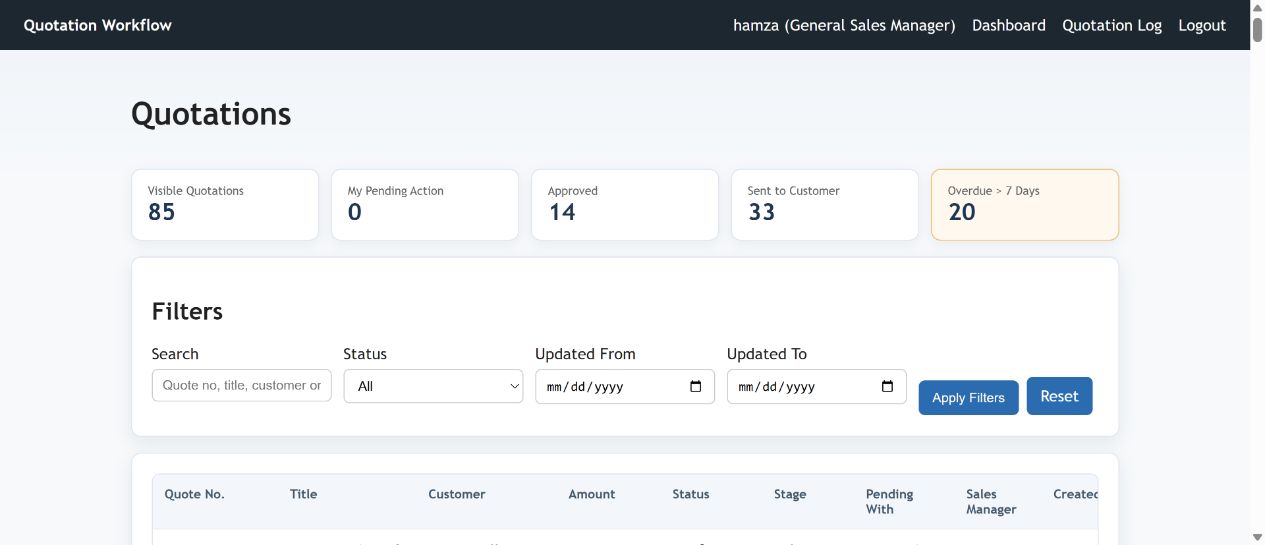
Quotation Workflow dashboard showing quotation status, review stages and operational filters
Quotation Workflow application dashboard. On-screen record counts are interface evidence, not published performance claims.
Business problem

Preparing a quotation required information to move through disconnected stages: supplier documents, pricing calculations, commercial adjustments, internal checks and final customer-facing output. Repetitive handling increased turnaround time and created avoidable risk around transcription, calculation consistency, version control and document quality.

Architecture

Supplier quotation and project inputs → structured data extraction → item and pricing normalization → commercial calculation rules → controlled review → branded quotation output.

Challenge

The workflow had to preserve the detail and structure of technical supplier offers while applying internal commercial logic consistently, without hiding assumptions or removing human control from commercially sensitive decisions.

Solution

Designed an end-to-end quotation workflow that organizes source documents, maps line items into a consistent structure, applies defined cost and pricing inputs, and generates a standardized quotation for review. Source data remains separate from calculated values so commercial decisions stay visible and traceable.

Business impact

Consolidated a fragmented quotation process into one controlled workflow, reducing repeated data handling and improving consistency across calculation, review and presentation. Exact time savings, error reduction and quotation-volume metrics require a confirmed operating baseline.

Technology

Workflow automation, Python, Excel, structured document processing, pricing logic, PDF and spreadsheet outputs

My role

Process analysis, workflow architecture, calculation design, automation development, output standardization and validation.

Lesson

Quotation automation is reliable only when source values, assumptions, commercial adjustments and approvals remain clearly separated and traceable.

Future improvement

Centralized quotation history, approval thresholds, CRM integration, automated revision comparison and reporting on turnaround time, win rate and margin quality.
02 / AI · Documents · Sales Automation

Q_Gen 2.0

Implemented second-generation workflow. Production scale, adoption and commercial performance metrics require confirmation.

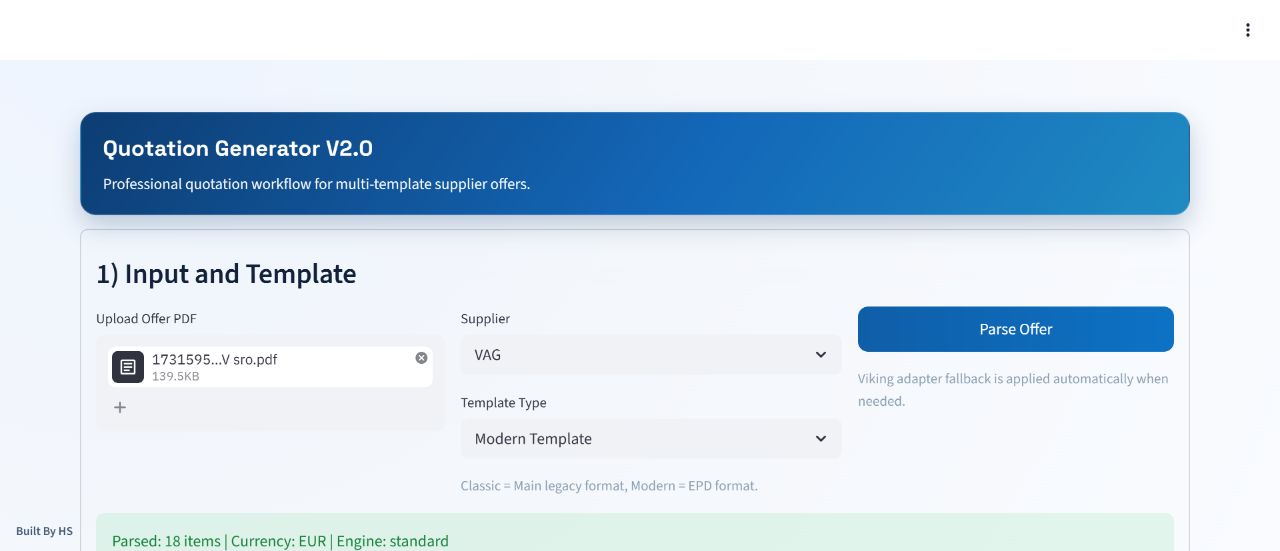
A second-generation quotation engine that converts variable supplier offers into traceable costing and standardized Excel quotations.

Application evidence supplied
Quotation Generator version 2 interface with supplier PDF upload, template selection and parsing controls
Q_Gen 2.0 quotation preparation interface using a supplier offer and controlled template selection.
Business problem

The quotation process still depended on substantial manual interpretation, spreadsheet handling and document assembly. Supplier offers varied in format and complexity, while freight, inspection, currency and commercial adjustments had to be applied accurately before producing a customer-ready quotation.

Architecture

Supplier PDF → document extraction and item mapping → normalized quotation model → landed-cost and pricing calculations → review checkpoints → standardized Excel quotation.

Challenge

The system had to interpret inconsistent supplier documents without inventing missing data, preserve technical descriptions and quantities, apply commercial inputs transparently, and fit an established company quotation template.

Solution

Rebuilt the workflow around a structured quotation model. Q_Gen 2.0 extracts and organizes supplier-offer content, maps it into the required workbook structure, applies explicit commercial inputs such as freight and third-party inspection, and produces a review-ready quotation with visible exceptions.

Business impact

Reduced repeated document handling and created a more consistent path from supplier offer to internal costing and customer quotation. Exact throughput, time-saving, accuracy and margin-impact figures require measured production evidence.

Technology

Python, PDF extraction, structured data mapping, Excel automation, formula-driven costing, template-based generation and validation controls

My role

Product definition, workflow redesign, data-mapping logic, costing architecture, generator development, template integration and output verification.

Lesson

AI-assisted document automation should surface uncertainty and preserve source traceability; it should never silently convert ambiguous inputs into commercial facts.

Future improvement

Confidence-based exception queues, supplier-format learning, revision comparison, approval workflows, ERP or CRM integration and portfolio-level quotation analytics.

03 / AI · Documents · Workflow

PDF Extractor: Document Intelligence Studio

Verified end-to-end review workflow. Live service activation requires administrator confirmation.

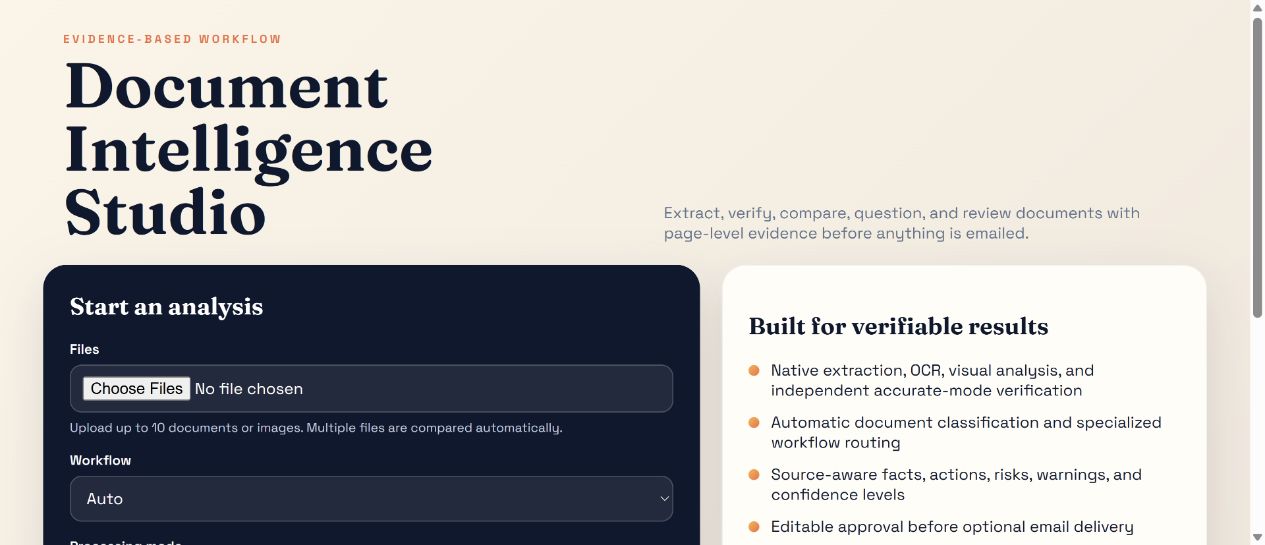
An evidence-aware extraction platform with hybrid OCR, structured analysis, source citations and a verified human-review workflow.

Application evidence supplied
Document Intelligence Studio interface for uploading and reviewing evidence-based document analyses
Document Intelligence Studio entry screen showing governed upload, extraction and review capabilities.
Business problem

Important information was locked inside PDFs and related business documents, including scanned pages and inconsistent layouts. Manual extraction was slow and difficult to standardize, while basic text extraction could not provide sufficient structure, confidence or source traceability.

Architecture

PDF, image or Office file → native extraction or OCR → document classification → structured analysis → evidence citation and confidence checks → human review → export or email.

Challenge

The system needed to support digital and scanned documents, preserve links between extracted claims and source evidence, handle background processing safely and produce outputs a reviewer could validate before operational use.

Solution

Developed a hybrid document-intelligence workflow combining native extraction and OCR, classifying incoming files and transforming their contents into structured results with citations, confidence indicators and warnings. The application supports cited question answering, approval, recovery and controlled export.

Business impact

The end-to-end review workflow was verified through 16 automated tests and 3 of 3 live evaluation cases covering routing and citation quality. Commercial time savings, extraction-volume capacity and operational accuracy require a confirmed production baseline.

Technology

Python, Flask, OpenAI structured outputs, OCR, PyMuPDF, SQLite, background jobs and PDF, CSV and JSON export

My role

Workflow architecture, ingestion and extraction design, structured-analysis logic, citation and review controls, application development, test coverage and live evaluation.

Lesson

Document extraction becomes operationally useful only when evidence quality, uncertainty and reviewer control are treated as core system requirements.

Future improvement

Complete administrator service activation, add production monitoring, expand document-specific evaluation sets and establish business KPIs for accuracy, handling time and exception rates.

04 / Digital Forms · Workflow · Operations

MAS Forms

Completed forms workflow. Form count, submission volume and measured processing improvement require confirmation.

A coordinated forms system that improves data quality at submission and creates a consistent path from operational intake to review and action.

Application evidence supplied
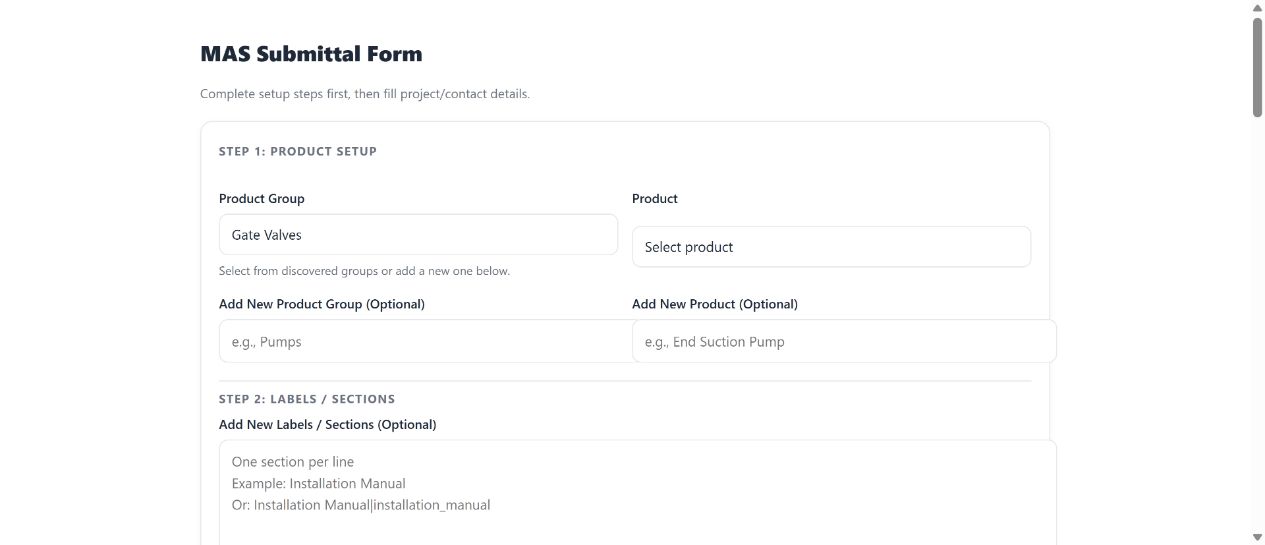
MAS Submittal Form interface with product setup and structured section controls
MAS Submittal Form showing structured product setup and configurable submission sections.
Business problem

Operational information was captured through inconsistent or manually handled forms, making submissions harder to validate, route, review and reuse. This created gaps in data quality, slowed follow-up and weakened the operational record.

Architecture

User input → conditional form logic → field validation → structured submission → notification or routing → review and operational record.

Challenge

The forms needed to remain simple for users while capturing enough structured information for downstream action. Field logic, validation, ownership and handoffs had to work as one process rather than as isolated screens.

Solution

Designed and implemented a coordinated digital-forms system with clear field structures, validation rules and workflow-aware submissions. The solution improves completeness at the point of entry and prepares each submission for review, routing or follow-up without unnecessary re-entry.

Business impact

Established a more consistent intake process and a cleaner operational record, reducing ambiguity between submission and action. Quantified completion rates, processing-time reduction and error-rate improvement require production data.

Technology

Digital forms, conditional logic, data validation, workflow automation, structured records, notifications and reporting-ready data

My role

Requirements mapping, form architecture, field and validation design, workflow logic, implementation and usability review.

Lesson

A form creates value only when its data model and post-submission workflow are designed together.

Future improvement

Role-based dashboards, SLA tracking, analytics, automated reminders, system integrations and a reusable form-component library.

05 / IoT · APIs · Residential Automation

Complete Smart Home Villa

Verified live local implementation.

A unified control layer representing 21 live devices, 78 aligned actions and a verified durable local runtime.

Application evidence supplied
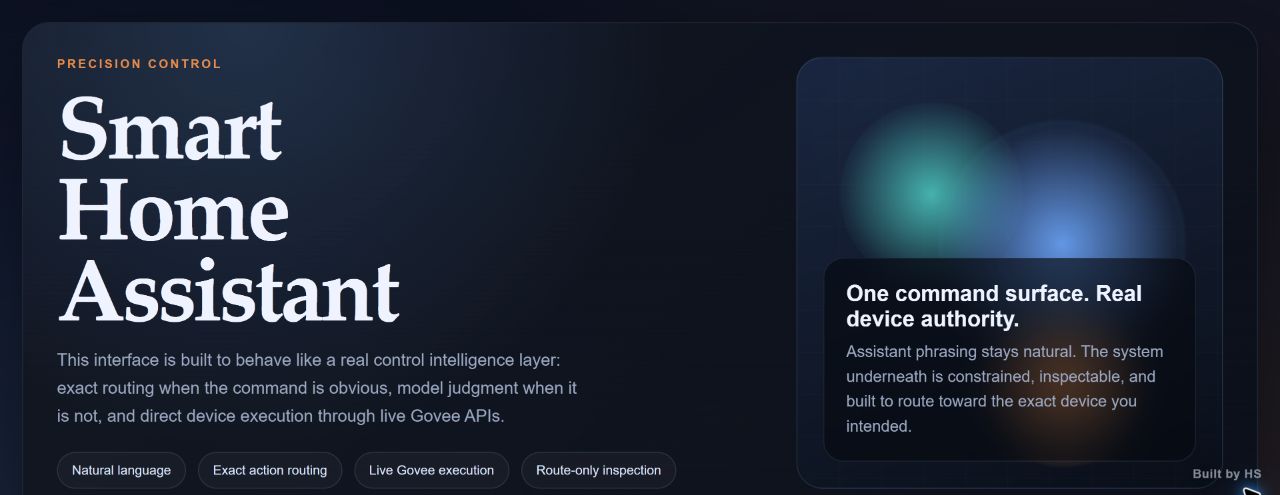
Smart Home Assistant interface describing natural-language routing and live Govee device execution
Smart Home Assistant control surface connected to the verified villa device capability layer.
Business problem

The villa’s smart devices were distributed across vendor ecosystems and exposed through different capabilities, interfaces and APIs. Existing control covered only part of the live device inventory and did not provide one dependable operating view.

Architecture

Vendor device discovery → merged inventory → normalized capability model → command adapters → room- and role-based interface → durable local runtime.

Challenge

Legacy API coverage did not represent every live device, device capabilities varied by model, and the control service needed to run reliably without interfering with an older application already installed on the system.

Solution

Built a unified smart-home layer that merges available device inventories, identifies real capabilities and presents controls according to how each device is used in the villa. Commands are aligned through a normalized capability model and delivered through a durable local service.

Business impact

The delivered system represented 21 live devices, aligned 78 Govee actions, introduced four brightness presets, and was verified through a working local runtime returning HTTP 200.

Technology

Python, Flask, Govee OpenAPI, REST APIs, OpenAI Responses API, NSSM and PowerShell

My role

Live-device audit, API integration, capability modeling, control-interface design, command mapping, service deployment and runtime verification.

Lesson

Smart-home reliability depends on live capability discovery and graceful handling of vendor differences—not assumptions derived from a single legacy endpoint.

Future improvement

Broader vendor adapters, sensor- and event-driven automation, health monitoring, telemetry and secure remote access with role-based controls.

06 / AI · Education · Interactive Learning

Math Tutor

Completed implementation. Curriculum coverage, learner usage and educational outcome metrics require confirmation.

An adaptive tutoring experience that guides learners through mathematical reasoning with staged explanations, answer checking and targeted feedback.

Application evidence supplied
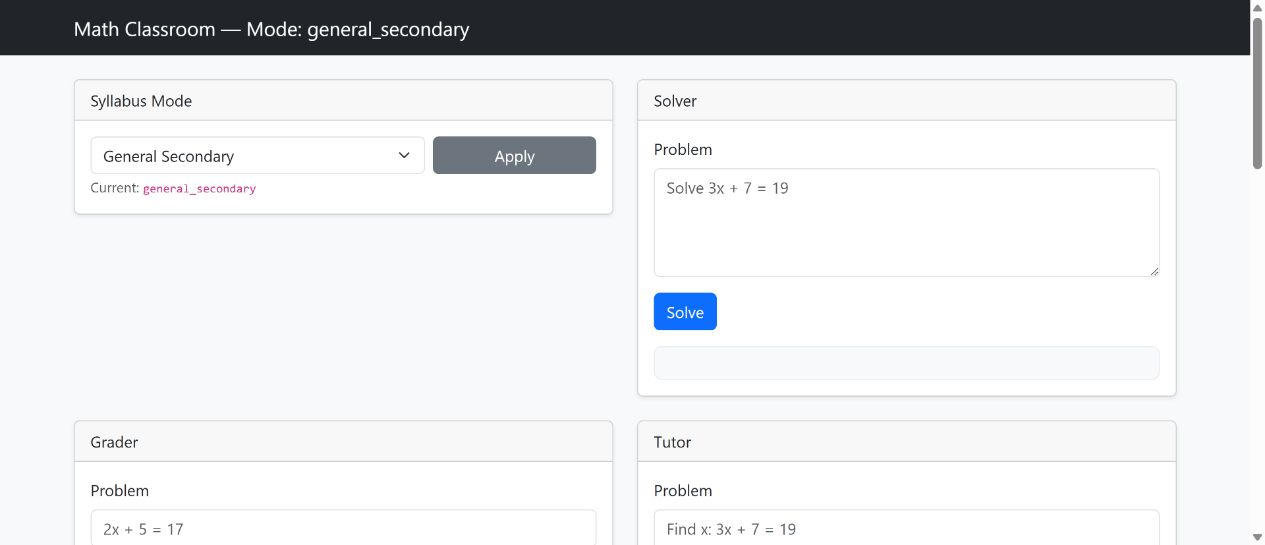
Math Classroom interface with syllabus selection, solver, grader and tutor panels
Math Tutor classroom interface showing syllabus mode and separate solver, grader and tutoring workflows.
Business problem

Students often need immediate, individualized support while solving mathematics problems, but conventional answer tools tend to provide a final result without diagnosing misunderstanding or developing reusable reasoning.

Architecture

Learner question → problem and intent analysis → staged explanation → guided interaction → answer checking → targeted feedback and next step.

Challenge

The tutor needed to be mathematically reliable while adapting explanations to the learner’s level, distinguishing productive guidance from answer revelation and maintaining context across multiple steps.

Solution

Designed an AI-assisted tutoring workflow that breaks problems into understandable stages, asks focused questions and provides feedback based on the learner’s response. Students retain responsibility for the reasoning while receiving structured support.

Business impact

Created an accessible, repeatable tutoring experience capable of delivering structured support on demand. Verified figures for learner completion, answer accuracy, engagement and improvement require controlled evaluation data.

Technology

Generative AI, structured prompting, conversational workflows, mathematical notation, contextual feedback and web application interfaces

My role

Learning-experience design, tutoring logic, prompt and interaction architecture, application development, response-quality review and usability refinement.

Lesson

An effective AI tutor should optimize for understanding and productive struggle—not merely for producing a correct final answer.

Future improvement

Curriculum mapping, difficulty adaptation, learner profiles, progress analytics, educator dashboards and a formal evaluation set for mathematical accuracy and teaching quality.

07 / Web · Integration · UX

Dynamic file-preview landing pages

Verified template repair; client identity not provided.

Reusable file-sharing pages that preserve live image, PDF and video previews across generated links.

Technical evidence documented
Business problem

A reusable share-page template lost dynamic preview behavior when media examples were treated as static content.

Architecture

Reusable template → placeholder injection → generated image, video or PDF preview → browser-safe delivery.

Challenge

Preserving the generator contract while validating multiple media types without hard-coded content.

Solution

Removed static fallback assumptions, preserved dynamic placeholders and verified generated pages over local HTTP.

Business impact

Dynamic image, PDF and video preview behavior was restored. Usage and conversion metrics require confirmation.

Technology

HTML, CSS, JavaScript, DropShare placeholders and local HTTP validation

My role

Template analysis, dynamic placeholder repair, cross-media validation and browser testing.

Lesson

Generated samples demonstrate the contract; they should not be copied back into reusable source.

Future improvement

Automated regression fixtures across media types.

08 / Content · RTL · Web

Arabic healthcare website localization preview

Verified deliverables; publication status requires confirmation.

A structured Arabic localization and owner-review workflow that preserves the live website’s business intent.

Technical evidence documented
Business problem

Arabic copy needed stronger clarity and professionalism without changing the live website structure or business intent.

Architecture

Live page inventory → visible-string map → Arabic copy deck → structured RTL owner preview.

Challenge

Arabic was layered onto English pages rather than maintained in a separate page tree.

Solution

Mapped the public pages, rewrote business-critical content and created a single-file owner review experience.

Business impact

A review-ready Arabic copy deck and visual preview were produced. Publication and commercial metrics require confirmation.

Technology

WordPress REST API, GTranslate-aware content mapping, RTL HTML and hosted-preview workflow

My role

Content inventory, localization strategy, Arabic copy development and review-preview design.

Lesson

Localization quality depends on preserving intent and page structure, not literal replacement.

Future improvement

Owner approval, production update and Arabic search optimization.

09 / Web · Flask · QA

Responsive World Cup 2026 information page

Verified source and routes; production refresh requires confirmation.

A responsive public information experience with corrected mobile reading order and reliable route access.

Technical evidence documented
Business problem

A new public page needed mobile reading-order corrections and reliable access with or without a trailing slash.

Architecture

Static experience → public route policy → Flask delivery → route and syntax validation.

Challenge

Mobile visual order and an authentication edge case on the slash variant.

Solution

Refined responsive order, made both route variants public and verified behavior with the application test client.

Business impact

Both route forms validated and key mobile issues corrected. Audience metrics require confirmation.

Technology

HTML, CSS, JavaScript, Flask routing and test client

My role

Responsive UX review, route-policy correction, Flask integration and regression verification.

Lesson

A polished page is not complete until route, authorization and mobile behavior agree.

Future improvement

Live service refresh and content analytics.

10 / Cloud · DNS · Security

Cloudflare DNS and email-authentication review

Verified live technical review; domain relationship requires confirmation.

A live-state review of domain authentication controls before recommending stronger enforcement.

Technical evidence documented
Business problem

A domain’s DMARC and BIMI posture needed live verification before any enforcement recommendation.

Architecture

Authoritative record checks → provider alignment → policy-gap analysis → staged recommendation.

Challenge

Local DNS lookups were unreliable and policy changes could affect legitimate mail.

Solution

Verified records through a reliable public resolver, mapped provider dependencies and separated current state from recommended tightening.

Business impact

Confirmed the live authentication baseline and identified prerequisites for safer enforcement. Delivery and fraud metrics require confirmation.

Technology

Cloudflare, DNS, DMARC, BIMI, SPF, DKIM, iCloud custom domain and PowerShell

My role

Live DNS verification, email-provider dependency mapping, risk analysis and staged policy recommendation.

Lesson

Security recommendations must start from the live record set, not assumed configuration.

Future improvement

Aggregate-report review, staged policy enforcement and BIMI prerequisites.

Start with the business case

Need an implementation partner who shows the evidence?

Bring one process, integration problem or operating constraint. We will define the right first step—without forcing AI where simpler engineering works better.

Discuss your project